


Aug 24, 2026

Ask people to name healthcare careers and they will list nurses, doctors, and therapists all day before anyone says phlebotomist. Yet almost every diagnosis in medicine starts with a blood draw, training takes months instead of years, and the role opens more doors inside healthcare than nearly any other entry point.
Phlebotomy carries a set of myths that keep good people from considering it. Here is each one, next to the reality.
Reality: most phlebotomy training programs run four to eight months, and some accelerated certificate programs finish faster. Compare that with two to four years for nursing or therapy assistant tracks and phlebotomy is one of the quickest legitimate routes to a clinical badge.
Most states do not require a license, though a handful do, California most notably, so check your state's rules before enrolling. What employers nearly always want is certification through a recognized body such as ASCP, NHA, or AMT, plus documented draws from your training program. Choose a program by its clinical hours, because a graduate with several hundred successful sticks interviews very differently than one with fifty.
Reality: the draw is the visible ten percent. The job is patient management under pressure. Phlebotomists calm needle-phobic adults, work with pediatric and geriatric veins, verify identities where a mislabeled tube can change a diagnosis, and keep specimen integrity intact from arm to lab. The skill ceiling is higher than the job title suggests, and hiring managers know the difference between someone who can perform a draw and someone who can run a morning of forty of them without an error.
That mix of technical precision and bedside composure is exactly the profile the rest of healthcare hires for, which leads to the next myth.
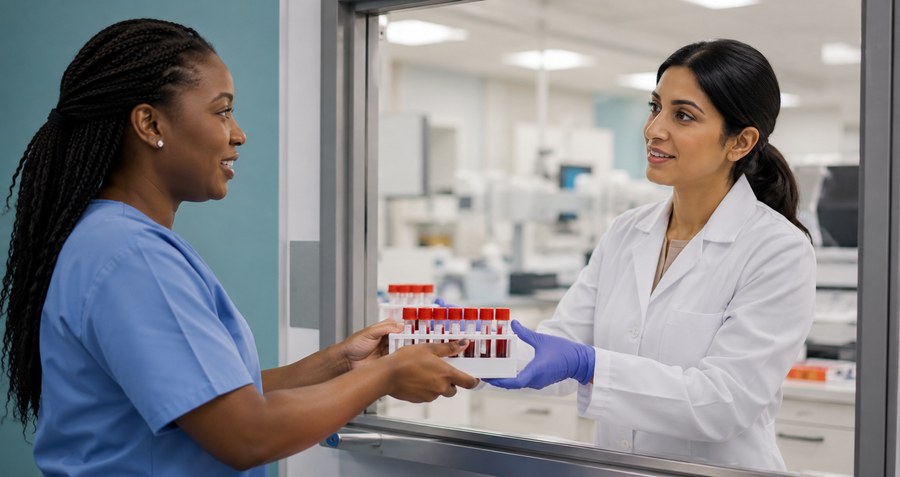
Reality: phlebotomy might be healthcare's best-connected role. The lab side leads to specimen processing, laboratory assistant work, and with further education the medical laboratory technician and scientist tracks. The patient side leads to patient care technician, dialysis technician, and EKG-combined roles, and phlebotomy experience is a proven springboard into nursing school with clinical exposure most applicants lack. There are also paths people rarely consider: donor centers and blood banks, mobile phlebotomy for home health and insurance exams, and lead or supervisory roles running hospital draw teams.
The Bureau of Labor Statistics projects continued growth for the field, and every one of those adjacent tracks is hiring too. The role is only a dead end if you stand still in it, and the credential-stacking path we mapped in the role of continuing education in healthcare careers applies to phlebotomists better than almost anyone.
Reality: base pay for entry phlebotomy is modest, and pretending otherwise would insult your intelligence. But the levers move quickly. Hospital positions generally outpay clinics and draw stations. Night, weekend, and float differentials add real money. Dual certifications, EKG or patient care tech alongside phlebotomy, raise your rate because one hire covering two functions is a bargain for any employer. And the branch roles above, dialysis tech, MLT, donor center leadership, each step pay meaningfully upward.
In a state like Florida, where lab and hospital demand keeps climbing with the population, those levers are all in reach. We broke down which metros are hiring hardest in our Florida healthcare job market guide.
Hospitals run the biggest draw teams and the early-morning rounds, and they hire constantly. Outpatient labs and patient service centers, the Quest and Labcorp world, offer steadier daytime hours. Physician offices and clinics want the phlebotomist who can also room patients. Blood donation centers trade needle-in-vein repetition for a mission-driven environment. Mobile phlebotomy offers independence and mileage in exchange for windshield time. New graduates weighing these settings against each other will find our tips for new graduates entering the healthcare job market worth ten minutes.
The honest summary: phlebotomy is not the highest-paying job in healthcare. It is the fastest respectable entrance, one of the most transferable skill sets, and a role where being genuinely good gets noticed fast.
Here is the problem phlebotomists share with every high-volume role: on a normal job board, your application is one resume in a stack of two hundred that all say "certified phlebotomist."
ProfiHitch works differently. Your profile leads with verified skills, settings, and what you want from your next role, employers search on exactly those, and nobody sees your name until you both opt in. For a role where the difference between candidates lives in the details, that is the difference between being found and being buried. Create your free profile, list the certifications and draw volume that set you apart, and let the right lab or hospital come to you.

Whether you're an employer seeking top-tier healthcare professionals or a job seeker looking for the perfect role, ProfiHitch offers a discreet, modern solution to meet your needs.
Copyright © 2026 ProfiHitch. All rights reserved.